Why I Love A Map
The first map I remember is a road map unfolded across the hood of our Chevy station wagon.
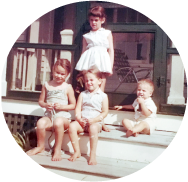
It was the summer of 1960, the start of a long New England drought. We were on our way to Boston. My mom was driving us girls—Elise, age 4, me, age 6, and Eve, age 8—along with our babysitter, Caroline, three cats, and a turtle. At first, we spent the time singing and playing guessing games. But it got hotter and hotter until finally, we just wanted to stay as still as possible. This was before cars had air conditioning. Even with the windows rolled down, the car was too hot. I remember the green blur of trees outside the windows, looped by the telephone lines that came in and out of view.
We got lost somewhere in Connecticut or southern Massachusetts. The road seemed to get smaller and smaller. Finally, we pulled over by a small river and piled out of the car. But the air didn’t feel any cooler. The river reflected the sunlight, making the air bright, so you had to squint. We wandered down to the river, our pastel seersucker playsuits sticking to us. Should we go in? Caroline had stayed in the car, so it was the three of us.
Then we heard a car door open. In the sparse shade, hidden under some trees, was a car. A man got out and walked towards us, smiling. He kept smiling, and I thought, "he's smiling, but he's not friendly." "Are you lost?" he asked, speaking softly.
I felt the word ‘Lost’ physically. A few weeks before, I had gotten lost. I had gotten on the wrong bus coming home from school. I was the last kid off in a neighborhood I didn't recognize. I felt a cold lump come up under my sternum, and the hair stood up on the back of my neck. "It's okay to go in," he continued, "No one minds if you take off your clothes.” I looked over to our car.
Our mom had stayed in the car too, when we'd gotten out. She was rummaging in the glove compartment. But I saw her now; she'd gotten out and was looking at a large piece of paper on the hood of the car. I couldn't exactly tell what she was looking at, but the paper was very big and colorful.
I should add that my mother had amazing hearing. She was a musician and a pianist. She could hear a pin drop. I have ears like a lynx, she liked to say. We had experienced her amazing hearing, never being able to whisper quietly enough to keep a secret from her. "No," my mother said, looking up from the car's hood. "We are not lost. I have found us on the map. Back in the car, everyone." I realized I had been holding my breath. The man shifted his gaze to a speck far up in the empty sky.
The answer to finding our way was on a colorful piece of paper, a map. My mother could read this. Someday, I will read this too, I thought. The map found us—an answer and the right one.